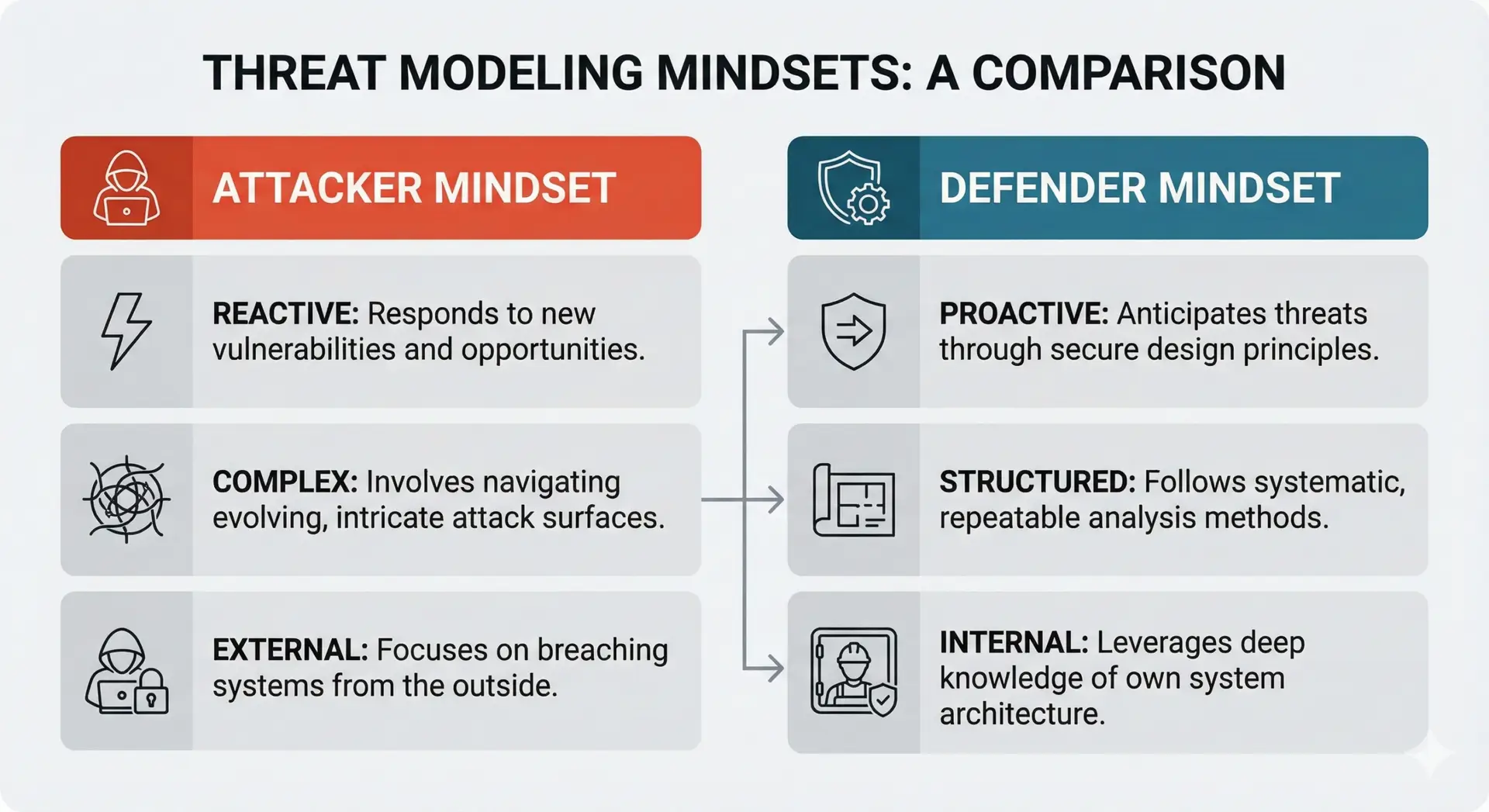

“Think like an attacker.” It’s our industry’s favorite mantra, but for most engineering teams, it’s a setup for failure. It expects developers – who spend their days perfecting “happy flows” – to suddenly pivot into a destructive mindset that goes entirely against their nature.
This creates a bottleneck for organizations attempting to scale threat modeling, as engineers frequently find themselves paralyzed by “creator-blindness”—the natural cognitive inability to see flaws in a system they have specifically designed to succeed. To overcome this paralysis, many teams turn to GenAI for rapid answers, only to be caught in a validation gap where they lack the specialized security expertise required to distinguish between a helpful insight and a dangerous hallucination.
The truth is, you don’t need more “attackers” on your payroll. You need to lean into the Defender’s Advantage. Here’s why shifting the focus back to your own domain is the better way to make threat modeling stick.
The Myth of the "Attacker Mindset"
Telling a developer to think like an attacker is like telling a home cook to “think like a Michelin-starred chef”. In our threat modeling training, we often say: “When I’m in the kitchen, my wife saying ‘Think like Jamie Oliver’ doesn’t make me a better chef.” It’s a nice sentiment, but it isn’t prescriptive or clear.
Most people don’t know how an attacker spends their day or what tools they use. When we demand this mindset, we often just make engineers feel siloed or embarrassed that they “don’t get it”.
Saying “It would be helpful to you if you learned to think like an attacker” is exhorting people to learn that skill. Demanding that they do it, or implying that they’re stupid for not knowing how to do it is actively counter-productive.
Adam Shostack, 2008